A synthesizable Max-Log-MAP decoder candidate for the LTE Turbo code, covering all 188 QPP block sizes from K=40 to K=6144. The current six-iteration, 5-bit-input build is routed on Zynq UltraScale+ RFSoC and checked on the board with an independent expected stream and a deliberately corrupted control.
Request datasheet & evaluationDevice xczu67dr-fsve1156-2-i, Vivado 2025.2, out-of-context post-route implementation; K=6144, six iterations, WINDOW=32, 5-bit channel input.
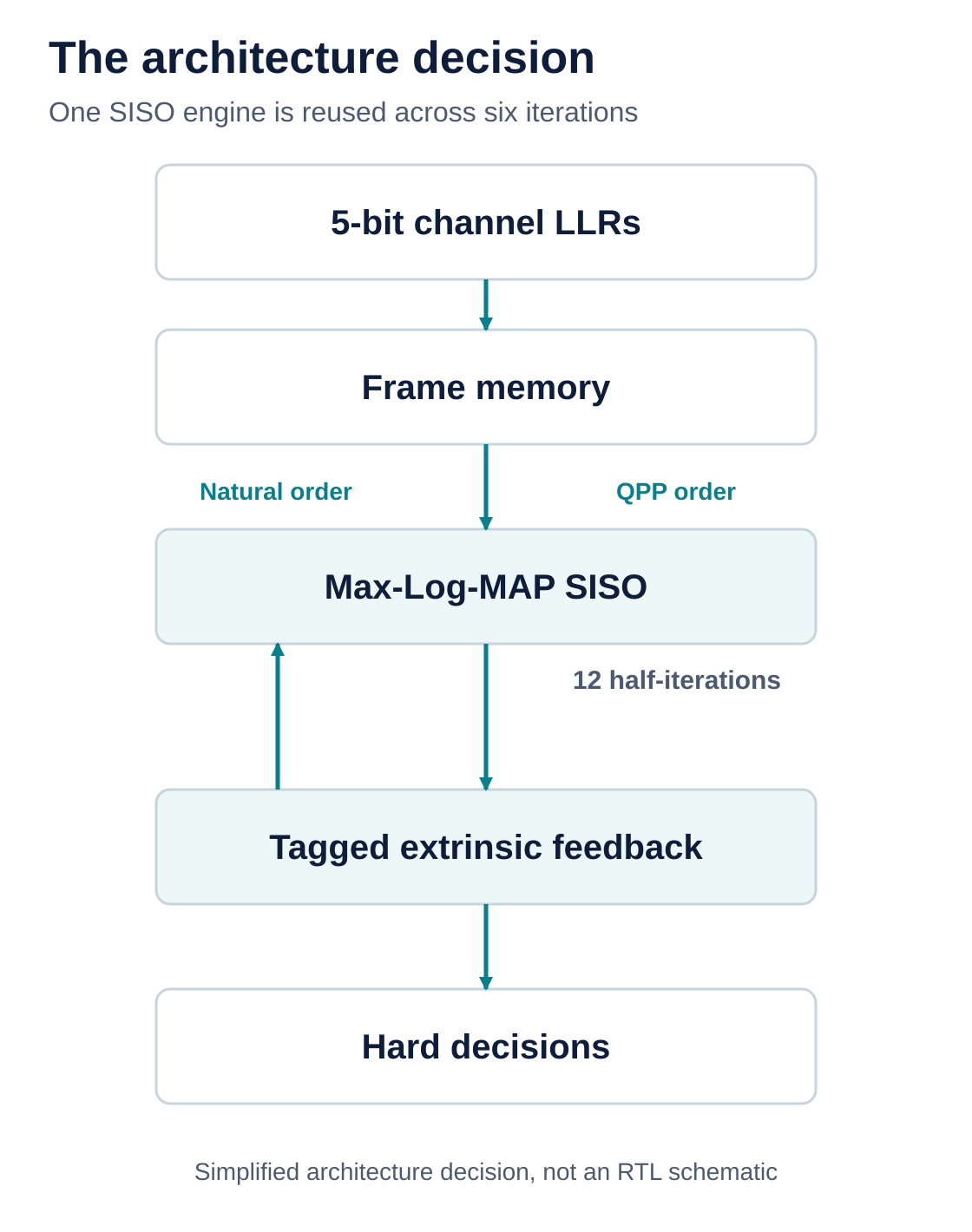
The current candidate time-reuses one Max-Log-MAP SISO engine through twelve half-iterations. Natural and QPP order are explicit, and extrinsic information returns with frame and phase identity attached. This keeps the architecture reviewable while supporting every legal LTE QPP block size.
Scope boundary. This decoder core does not claim CRC, rate matching, HARQ, code-block segmentation, or a complete LTE baseband. Those functions can be integrated as a defined system engagement.
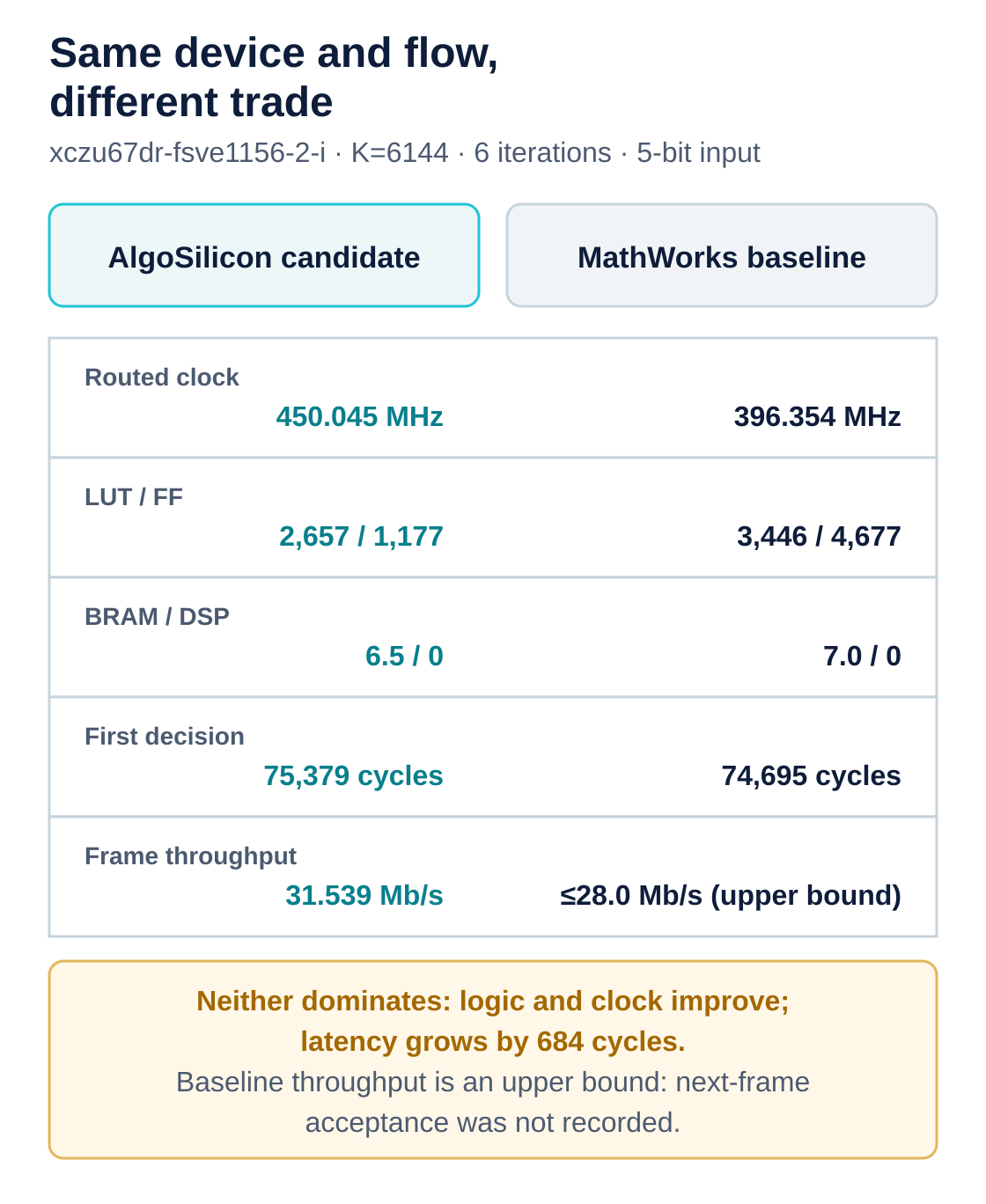
The comparison uses the same device, block length, iteration count, input precision and implementation flow. It is a Pareto comparison, not a single-number victory claim.

| Post-route result | AlgoSilicon candidate | MathWorks R2026a baseline |
|---|---|---|
| Clock | 450.045 MHz MEASURED | 396.354 MHz MEASURED |
| Logic | 2,657 LUT / 1,177 FF MEASURED | 3,446 LUT / 4,677 FF MEASURED |
| Memory / arithmetic | 6.5 BRAM / 0 DSP MEASURED | 7.0 BRAM / 0 DSP MEASURED |
| First-decision latency | 75,379 cycles MEASURED | 74,695 cycles MEASURED |
| Frame throughput | 31.539 Mb/s MEASURED | ≤28.0 Mb/s MEASURED UPPER BOUND |
The candidate uses 789 fewer LUTs, 3,500 fewer flip-flops and 0.5 fewer BRAMs, while closing 53.691 MHz higher. It reaches its first decision 684 cycles later. The baseline did not record the next-frame acceptance boundary, so its throughput is deliberately reported only as an upper bound. Neither point dominates the other.
Verification crosses independent models, RTL runs, routed implementation, and board playback. The RTL conformance record covers 153 complete runs over nine operating points. The board stream covers five legal frame sizes from K=40 through K=6144, with 8,883 input words and 8,848 output decisions.
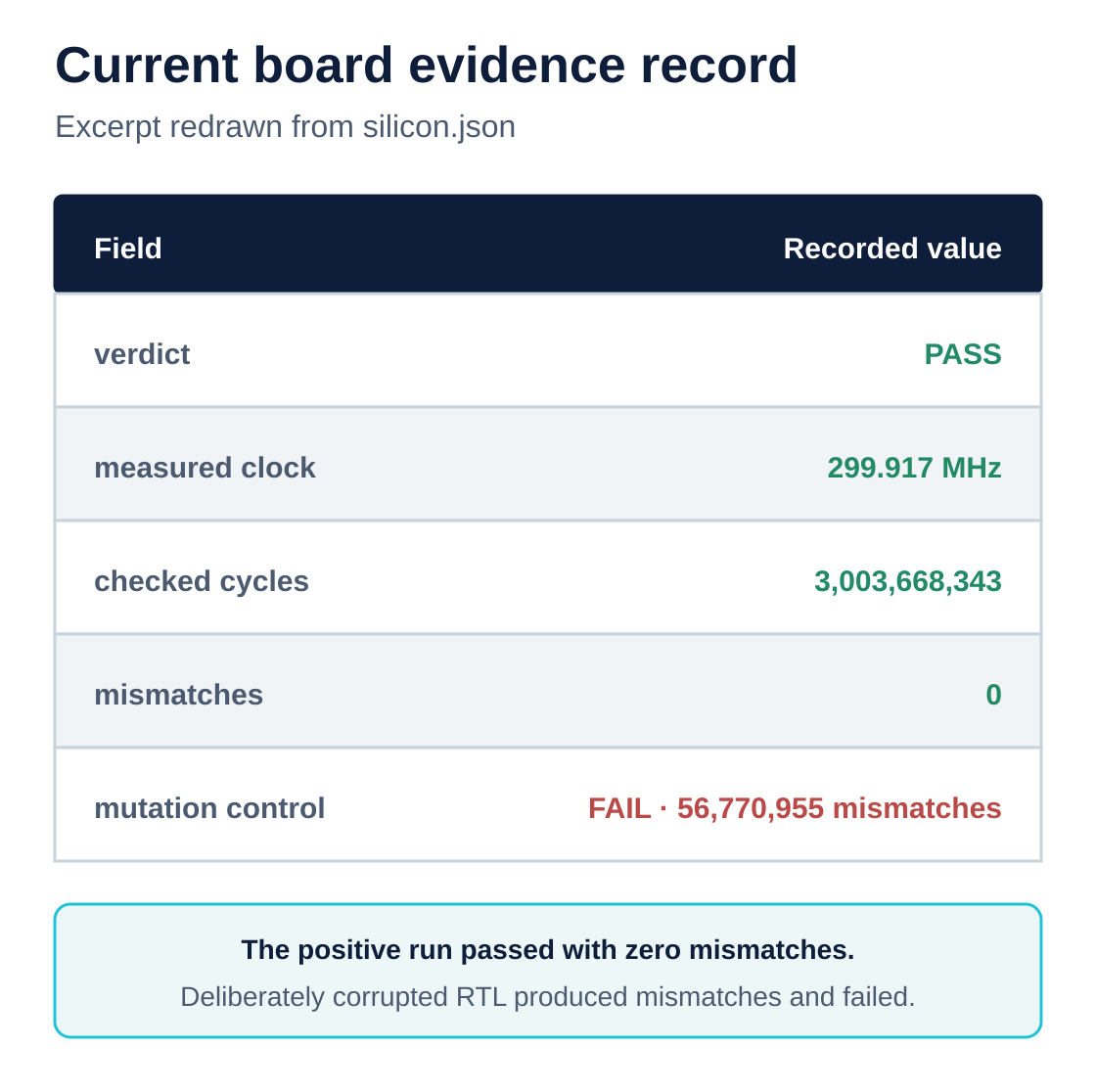
The current board record passed for 3,003,668,343 cycles with zero mismatches at 299.917 MHz. A deliberately mutated RTL build produced 56,770,955 mismatches and failed, showing that the checker can turn red.

We can package the candidate for your device, interfaces, throughput target and verification workload. Measured results remain tied to the configuration and flow that produced them.
Read the engineering case study: from task to board-tested RTL in two days.